


There is no meaningful way to answer the question of how much a Business Intelligence (BI) reporting project costs without first understanding its scope. The same requirement – “we want a management dashboard” – can represent two weeks of work or an entire year, depending on how many systems the data comes from, the quality of that data, and whether anyone has clearly defined what needs to be measured.
What can be described without knowing the scope is the cost structure. It is the same in every BI project and does not change from one vendor to another. Once you understand that structure, you can read any proposal – including one that is not ours – and immediately see what has not been included.
The Four Components of Every BI Project
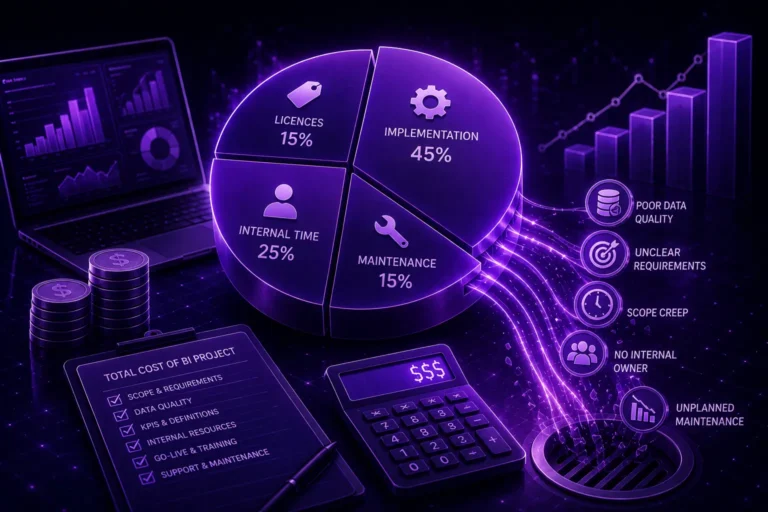
The first component is software licensing – the visualization platform, the database, and, where necessary, the data integration platform. This is the only part of the project cost that is publicly available and easy to compare, which is why it usually receives the most attention. In reality, licensing is typically a much smaller portion of the total project cost than implementation, yet discussions about licenses often consume a disproportionate amount of time.
The second component is implementation – requirements analysis, KPI definition, data preparation, report development, and testing. This is usually the largest item on the invoice and the only one that is genuinely negotiated.
The third component is internal effort. Your own employees need to explain business processes, define performance indicators, verify that the figures are correct, and learn how to use the new system. This cost never appears on an invoice or in a proposal, which is why it is almost never planned. In many of the projects we have delivered, it turned out to be the single largest cost component – and the most common reason for delays, because everyone assumed it would simply be done “along the way.”
The fourth component is maintenance. Data changes, systems are upgraded, and business requirements evolve. There will always be an annual maintenance cost. The only question is whether it has been planned from the beginning or whether it becomes an unpleasant surprise in the second year.
A proposal that covers only the first two components is not necessarily wrong – it is simply incomplete. If you treat it as the total cost of ownership, you are leaving out a significant portion of the real cost.
Why Quotes for the “Same” Project Can Differ by a Factor of Three
When three vendors provide three significantly different prices for what appears to be the same requirement, the first assumption is often that one of them is overpricing the project. More often, the reality is that the three proposals describe three different projects.
The biggest difference usually lies in whether the quality of the source data has been assessed. A proposal that assumes the data is already clean will naturally be cheaper than one that includes data cleansing and harmonization -and it will only be accurate if that assumption proves to be correct.
The second difference is who defines the business metrics. If the vendor is responsible, the proposal includes additional analysis days. If the client does it, the proposal becomes cheaper – but the work has not disappeared. It has simply been shifted to internal resources that nobody has calculated.
The third difference is migrating existing data into the new system. Transforming historical data into a usable structure is often more demanding than creating the reports themselves, yet it is rarely mentioned in the initial project description.
The fourth difference is training and knowledge transfer. A proposal that ends with the technical delivery of the solution will always be cheaper than one that includes user training and knowledge transfer to your internal team. The cost difference may only be a few days of work, but the outcome is the difference between a system that is merely implemented and one that is actually used.
When comparing proposals, it is far more useful to compare the assumptions than the prices themselves. A proposal that explicitly states its assumptions is usually more realistic than one that does not – even if it is more expensive.
A proposal without clearly stated assumptions is not cheaper. It is simply more uncertain.
Five Places Where the Budget Gets Exceeded
Listed by how often we encounter them – not by the size of the financial impact.
1. The Source Data Has Not Been Assessed Before the Proposal
The issue only becomes apparent during implementation, when the project scope has already been agreed. Assessing the quality of the source data takes only a day or two and is the least expensive thing you can do before signing any contract.
2. Business Metrics Are Defined During Implementation Instead of Before
If a business metric changes after a report has already been developed, the report has to be rebuilt rather than simply corrected. Three changes of this kind can easily cost the project an entire month.
3. Additional Data Sources Are Added After the Project Starts
Usually not because anyone intended to hide them, but because during discussions it becomes clear that another department maintains its own spreadsheet and that the overall picture is incomplete without it. Every additional data source requires its own mapping, cleansing, and testing.
4. The Budget Covers Implementation but Not Maintenance
The maintenance cost appears in the following budget year, when the project is no longer treated as an investment but as an operational expense that nobody planned for.
5. There Is No Internal Project Owner
If every decision about business definitions or priorities has to wait for a meeting – and no one is clearly responsible for organizing or making those decisions – the project does not stop; it simply takes longer. Longer projects cost more, even when the scope itself has not changed.
How to Reduce the Risk of Budget Overruns
One factor has a greater impact than all the others combined: the size of the first delivery.
A project whose first measurable result is delivered after nine months has no practical mechanism for course correction. The first meaningful feedback arrives only when every change has already become expensive.
A project that delivers its first result within four to six weeks – one production-ready report with a clearly identified business owner – creates an opportunity to adjust direction while changes are still inexpensive. This does not necessarily shorten the overall project, but it significantly reduces the likelihood of delivering something that nobody actually needs.
The second factor is defining the scope phase by phase, rather than fixing the scope of the entire project from the outset. Locking the entire scope at the beginning also locks in assumptions that have not yet been validated.
The third factor is the least technical, yet often one of the most important: appointing an internal project owner with decision-making authority. Not someone who simply forwards questions to management, but someone who can approve business definitions and make decisions.
Projects with such a person rarely exceed their deadlines for organizational reasons. Projects without one almost always do.
The Cost of Doing Nothing
Every discussion about the cost of a BI project is measured against an implicit alternative that is rarely calculated: continuing to work the way you do today.
That alternative is not free. It has a monthly cost in the hours your employees spend manually preparing reports, and it has a risk-related cost in decisions made using delayed or unreliable data.
The first cost can be calculated precisely – add up the hours, multiply them by the internal hourly rate, and then by twelve. The second can only be estimated by reviewing business decisions made over the past two years that turned out to be wrong because of poor or delayed data.
Without that number, every proposal looks expensive because it is being compared to zero. Once you have it, you are comparing it to a real cost.
Our experience is that the cost of business risk is almost always higher than the cost of the working hours involved – and yet it is almost never calculated.
Six Questions to Ask Your BI Vendor Before Signing
You can ask these questions to any vendor. We believe they are valuable precisely because they are not specific to us.
- Has the quality of the source data been assessed, and what is the estimate based on?
- Who is responsible for defining the business metrics, and is that included in the project scope?
- How many internal hours do you expect from our team, and during which project phases?
- What will be the first measurable deliverable, and when will it be available in production?
- What happens to the project cost and timeline if an additional data source is discovered?
- What exactly is included in the maintenance service, and how is it priced?
A vendor who answers these questions clearly has probably prepared a realistic proposal.
A vendor who treats them as a sign of distrust has already answered the most important question.
How to Get a Realistic Estimate
Any estimate made without reviewing the available data sources is simply a guess, regardless of how experienced the person making it may be.
The number of data sources, their condition, and the clarity of your business definitions have a far greater impact on the final project cost than the choice of BI platform.
If you need a realistic cost range rather than a number pulled out of thin air, we can help.
During a short consultation, we review how many data sources you have, what condition they are in, and what exactly you want to measure. Based on that, we can estimate the scope of the project and identify the main risks before implementation begins.
Contact us through our contact form or call us at +385 1 2430 700.